

Reducing the weight of a new energy vehicle (NEV) is a systematic engineering project that requires immense courage, said William Li, founder, chairman and CEO of Nio Inc (NYSE: NIO), as the company emphasizes lightweight design at a time when Chinese cars are getting heavier.
Shedding weight for NEVs holds great value for users, but achieving such a goal is not that simple, Li said in an interview with local media on Friday in Hefei, Anhui province.
Lightweighting is a comprehensive result of various aspects including cost, technology, engineering, and product definition, he said.
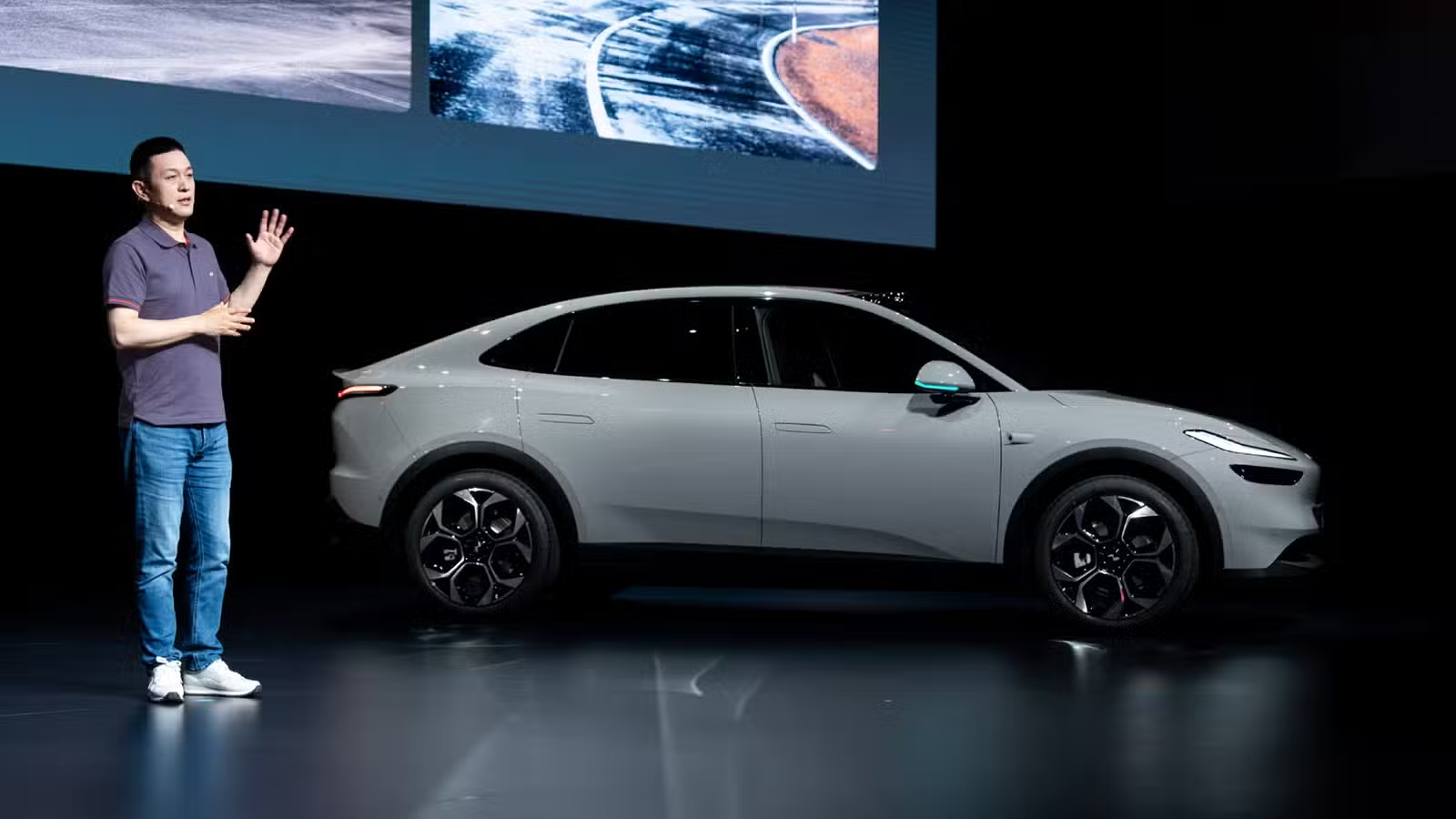
Nio’s sub-brand Onvo launched the updated version of the L60 mid-size electric SUV yesterday, and Li emphasized the vehicle’s lightweight design during the launch event.
The reason Onvo models and Tesla’s Model Y excel in lightweighting relies first on courage — the willingness to make trade-offs in configurations, Li said today.
If automakers blindly pursue ultra-long driving ranges while being constrained by costs, they are often forced to choose large-capacity lithium iron phosphate (LFP) batteries, which inevitably adds significant weight to the vehicle body, he said.
Tesla’s Model Y and Onvo models show relative restraint in battery selection. This restraint largely depends on an automaker’s judgment of the target users’ actual usage scenarios, Li emphasized.
He also detailed the escalating cost effect during the vehicle lightweighting process.
Reducing the weight of a smart EV from 2 tons to 1.9 tons is relatively easy, but attempting to reduce it further from 1.9 tons becomes increasingly costly per kilogram, Li said.
When vehicle research and development enters the final sprint phase, the cost of shedding 1 kilogram of weight is about 1,000 yuan ($148), he said.
Beyond trade-offs in product definition, the harder part of lightweighting lies in the realization of underlying technological capabilities. Using smart fuses as an example, he explained that it is not as simple as replacing parts in traditional cars.
Adopting smart fuses involves the redesign of the vehicle’s high-voltage and low-voltage architectures, as well as complex coordination among various subsystems, making it a systematic engineering project.
Automakers with stronger engineering capabilities are better able to avoid the awkward situation of „excessive use of materials without bringing actual safety benefits,“ Li said.
Excellent lightweight design not only saves precious social resources but also significantly improves the vehicle’s handling performance, he said.
The Nio CEO’s call for lightweighting comes as the Chinese auto industry faces a severe vehicle „obesity“ crisis.
The average curb weight of new passenger cars in China has surged to 1,704 kilograms in 2024, an increase of nearly 400 kg compared to 2012, state broadcaster CCTV said in a June 7 report.
More worryingly, the weight gain of passenger cars over the past four years has exceeded the total increase of the previous eight years combined, the report noted.
The auto industry’s transition to electrification, coupled with the upgrading of consumer demand, have jointly driven up vehicle weights.
To stand out in fierce market competition, many automakers use a single-charge driving range of 800 kilometers or even 1,000 kilometers as a core selling point, which means a massive power battery pack weighing 700 to 800 kg must be installed inside the vehicle, CCTV cited an industry expert as saying.
At the launch event for the updated Onvo L60 yesterday, Li emphasized that the model extensively uses high-strength lightweight materials and a new-generation ultra-thin battery pack, bringing its lightweight coefficient down to 2.22.
Its rear-wheel-drive version has a curb weight of only 1,885 kg, which is generally more than 300 kg lighter than pure electric models in the same class, he said.
($1 = 6.7753 yuan)




![BYD обяви, че цените на новия си луксозен спортен електромобил с мощност 1 500 hp започват от близо 200 000 долара [Снимки]](https://evnews.bg/wp-content/uploads/2026/07/BYD-Denza-Z-EV-prices-120x86.jpeg)
![BYD пуска на пазара новия модел „Seagull“ с LiDAR на цена от 13 000 долара, което е първата подобна инициатива в сегмента на електромобилите от начален клас [Видео]](https://evnews.bg/wp-content/uploads/2026/05/BYD-cheapest-EV-LiDAR-2-120x86.jpeg)
